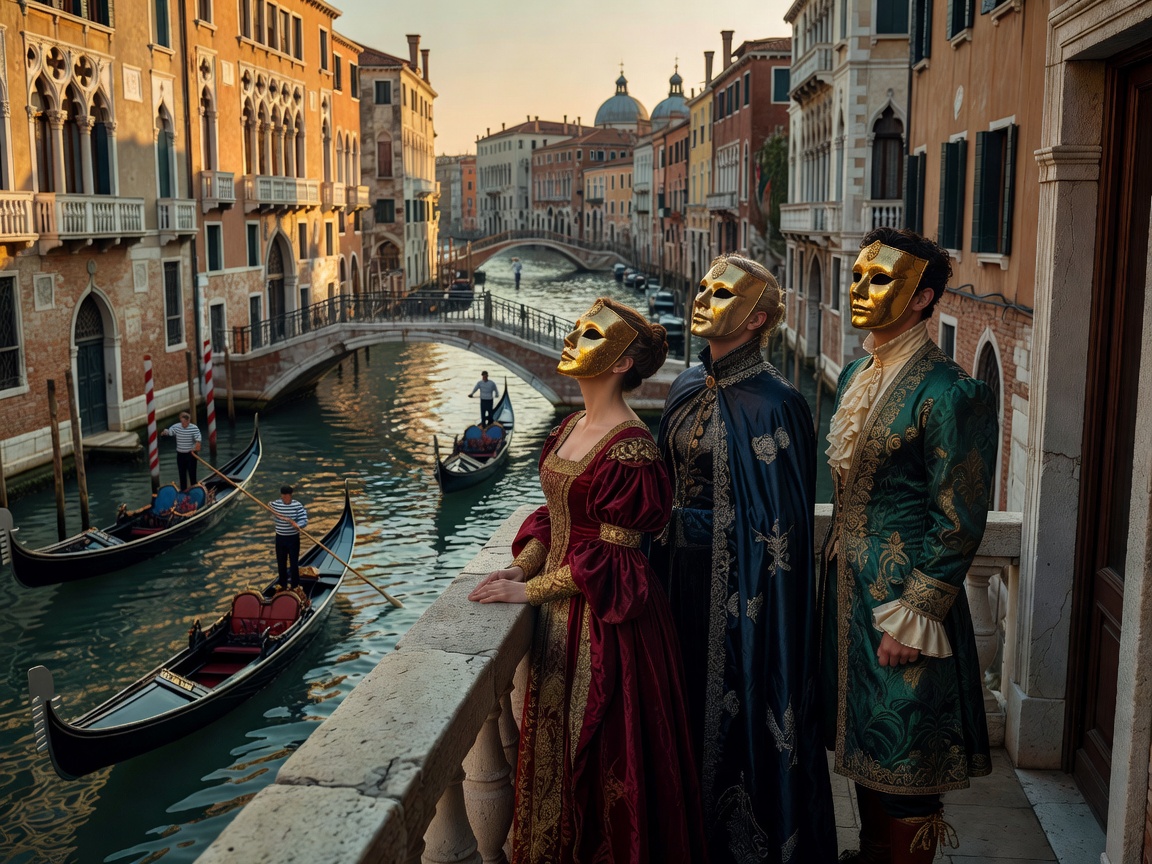
History of Venetian Masquerade
The origins of Carnevale date back to 1162, following the military victory of the Republic of Venice over the Patriarch of Aquileia. By the Renaissance and 18th-century Baroque era, the mask (maschera) became the great equalizer of the Serenissima Republic: under cover of anonymity, nobles and commoners mingled freely, satire flourished, and rigid social hierarchies temporarily collapsed.
Classic Venetian Mask Typologies
True Venetian masks are handcrafted from layered papier-mâché (carta pesta) and finished with gold leaf, antique craquelé varnish, and feathers. Key traditional designs include:
- The Bauta: A stark white mask with a sharply protruding lower chin designed to allow speaking, eating, and drinking without unmasking, paired with a black tricorn hat and dark cloak (tabarro).
- The Medico della Peste (Plague Doctor): Distinctive for its long conical beak, originally designed in the 17th century by Dr. Charles de Lorme to hold aromatic herbs against pestilence.
- The Moretta: A delicate oval black velvet mask historically worn by women, held in place by biting on an internal button, enforcing seductive silence.
- The Volto (Larva): A porcelain-white mask portraying neutral human features, often adorned with intricate gilding.
Unmissable Ceremonial Spectacles
The Festa Veneziana sull'Acqua (Water Pageant)
Opening the carnival period along the Rio di Cannaregio, floating theater structures and illuminated rowing barges drift along the canals amidst ambient operatic music.
Il Volo dell'Angelo (Flight of the Angel)
From the towering bell tower of the Campanile di San Marco, the winner of the previous year's Festa delle Marie descends gracefully on a zip-wire down into the crowded center of Piazza San Marco.
Attending Masquerade Balls in Historic Palazzi
For visitors seeking the ultimate immersive period experience, exclusive private balls (such as Il Ballo del Doge) take place in candlelit 16th-century palazzi along the Grand Canal. Note that strict period costume dress codes (18th-century Casanova-era attire) are mandatory for entry.